How to become a forward deployed engineer in 2027: skills, roadmap and Bildungsgutschein funding in Germany
What a forward deployed engineer does, why the role is growing so fast and which skills you need in 2027, with a realistic roadmap. Plus how a Bildungsgutschein can pay for the training and which Ai School program leads in that direction.
Video from YouTube
This video is hosted on YouTube. As with any embedded YouTube video, YouTube (Google) receives the usual technical data, such as your IP address.
Most companies have tried AI by now. Only a small share use it every day as part of how they work. A chatbot demo is easy. Connecting a model to a 15-year-old customer database, getting the data protection officer to sign off and making sure the system still works in three months is hard. Someone has to sit with the customer and do that work.
That someone is often a forward deployed engineer, or FDE. It has become one of the fastest-growing job titles in tech. In April 2026, FDE job ads on Indeed were up more than 729% on a year earlier, according to Indeed data shared with Business Insider. Lightcast data reported by Fortune shows more than 1,000% growth from January to August 2026 compared with the same months a year earlier.
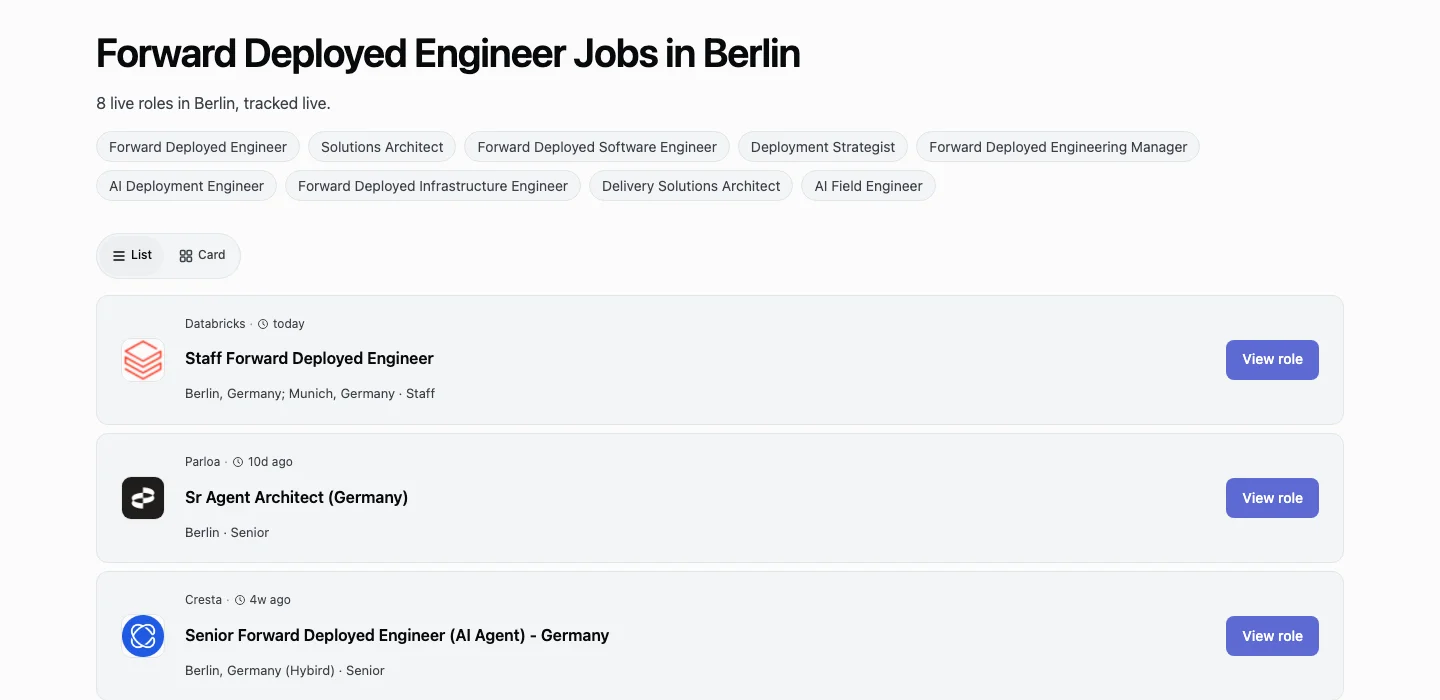
Germany is part of this. OpenAI, Anthropic and Databricks all had FDE roles open in Munich or Berlin in autumn 2026, and AI start-ups like Parloa, Cresta and Taktile are hiring for similar roles in Berlin. That is why Ai School offers several paths that lead toward FDE. All our programs can be fully funded with a Bildungsgutschein from the Agentur für Arbeit or Jobcenter if you are registered there and your advisor approves it. More on this in which Ai School program leads toward FDE.
This guide explains what the FDE is, which skills you need, a realistic roadmap, and how a Bildungsgutschein can pay for the training part of that path.
What a forward deployed engineer does
A forward deployed engineer is a software engineer who works directly with a customer to build and run software inside the customer's own systems. The role started at Palantir in the early 2010s, where it was called "Delta". Until about 2016, Palantir had more of these engineers than regular software engineers, according to The Pragmatic Engineer.
Today, most FDE jobs are at AI companies. Their customers buy a model or an AI platform, and the FDE makes it work for that customer. A typical project looks like this:
- Find out what the customer needs. Talk to the team that will use the system, look at their data and their current process, and agree on what "working" means.
- Build it. Write the code that connects the AI model to the customer's data, tools and older systems.
- Prove it works. Build tests and evaluations that show the system gives correct answers and does not leak data.
- Keep it running. Monitor it, fix problems and hand it over to the customer's own team.
- Report back. Tell the product team what customers keep asking for, so it can become part of the product.
How it differs from similar roles. A solutions architect or sales engineer mostly advises and builds demos. A consultant gives recommendations. An FDE writes code in the customer's environment and stays with the project until it runs. At OpenAI, for example, solutions architects rarely write code on customer systems, while FDEs do.
What the job is like. You split your time between coding, customer meetings and internal work. Travel is common. Palantir expects about 25% of the time on customer sites, and some companies say up to 50%. The OpenAI and Anthropic roles in Munich both mention travel.
Why it is a good field to aim for
- Demand is real and growing. The job-ad numbers above come from Indeed and Lightcast. Companies have bought AI tools and now need people who can make them work.
- AI companies are investing in it. In October 2026, Anthropic announced the Claude Frontier Academy, with a plan to train 10,000 "Frontier Deployed Engineers" by the end of 2027.
- Pay is high. In the US, the median advertised salary for FDEs was more than $188,000, compared with about $145,000 for software engineers (Lightcast, via Fortune).
- The skills are useful even if your job title is different. The same skills fit AI engineer, AI automation engineer, solutions engineer and implementation roles. If you work toward FDE and land one of those first, you have not wasted anything.
- It suits people who did something else before. FDEs need to understand how a business works, talk to non-technical people and explain trade-offs. If you have worked in sales, operations, consulting, healthcare or logistics, that experience counts.
Be realistic: this is not an entry-level job
We want to be clear about this, because many articles skip it. Most FDE jobs ask for experience.
FDE is not a beginner role, and most people come to it as full-stack developers, according to the roadmap.sh FDE roadmap. Anthropic's FDE role in Munich asked for 8+ years of experience, native German and fluent English, according to a review of German FDE job ads by Context Studios. Most FDE ads in Berlin are labelled Senior, Staff or Lead.
There are exceptions. Palantir hires people with about one year of experience after university. But for most people, the path looks like this:
- Learn the foundations: programming, web development, AI engineering and cloud.
- Get a first job where you build and deploy software, ideally with AI and ideally with customers.
- Move into an FDE role after one to three years, either inside your company or by applying elsewhere.
The training part of step 1 is where Ai School and a Bildungsgutschein can help.
The skills you need
The roadmap.sh FDE roadmap is the most complete public list we found. It groups the skills into these areas:
- Programming basics. One language well. The roadmap calls Python the go-to language for FDEs. You also need Git, the command line and basic data structures, because FDE interviews often start with a coding test.
- Full-stack development. Frontend (HTML, CSS, JavaScript, React) and backend (Node.js or Python, SQL, PostgreSQL, API design). You should be able to build a complete small app on your own.
- Data. Data modelling, data pipelines and data warehouses. A lot of FDE work starts with understanding a customer's messy data.
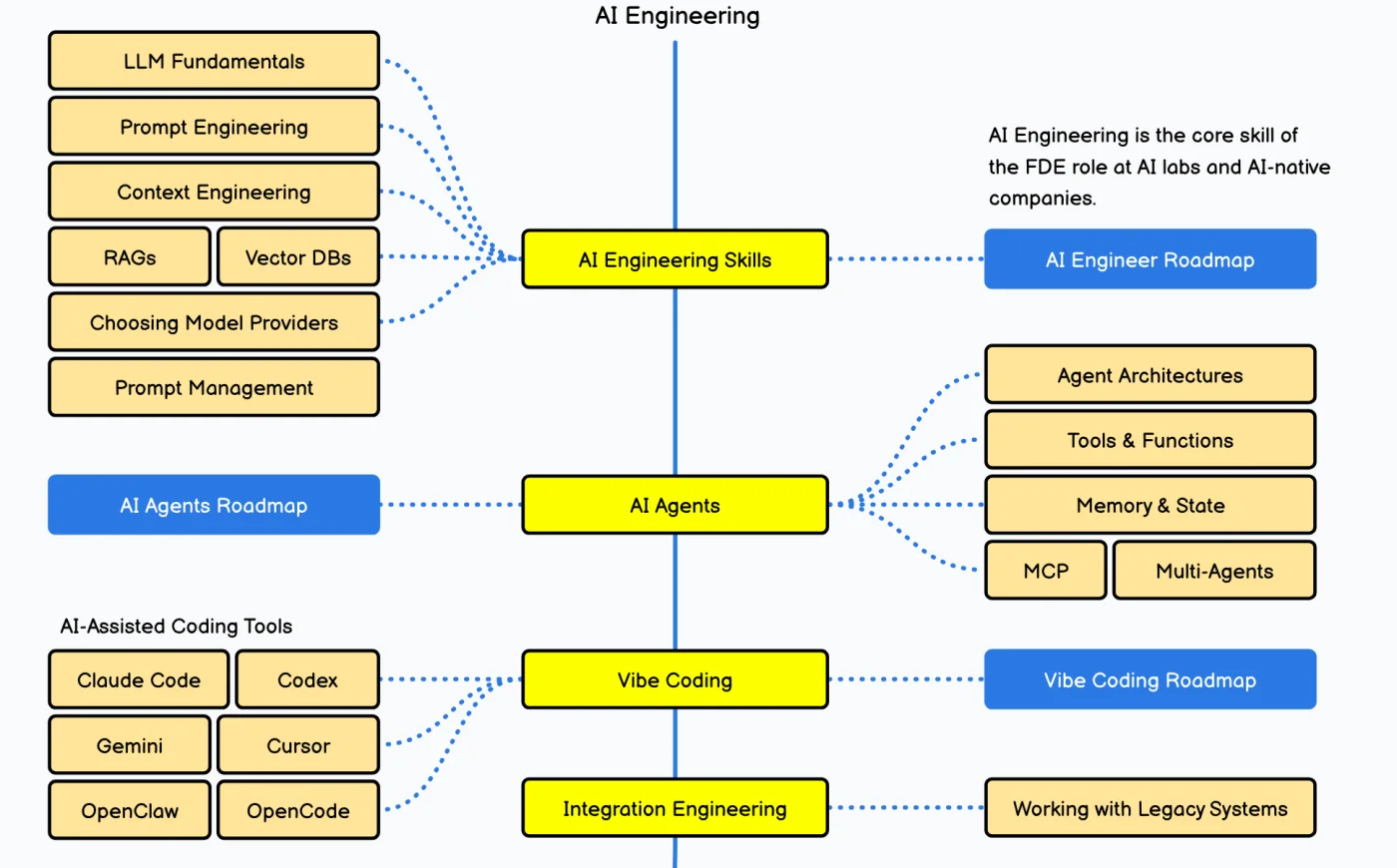
- AI engineering. How language models work, prompt and context engineering, RAG with vector databases, choosing a model provider, AI agents with tools and memory, and MCP.
- Integration. Connecting new systems to old ones through APIs, webhooks and events.
- Cloud and DevOps. At least one cloud platform (AWS, Google Cloud or Azure), Docker, CI/CD, infrastructure as code, and some Kubernetes.
- Production AI. Evaluations, monitoring, debugging agents, security, authentication, data privacy and AI governance. In Europe this includes GDPR and the EU AI Act.
- Customer skills. Requirements gathering, scoping, stakeholder management, measuring the business value, technical writing and presenting results to managers.
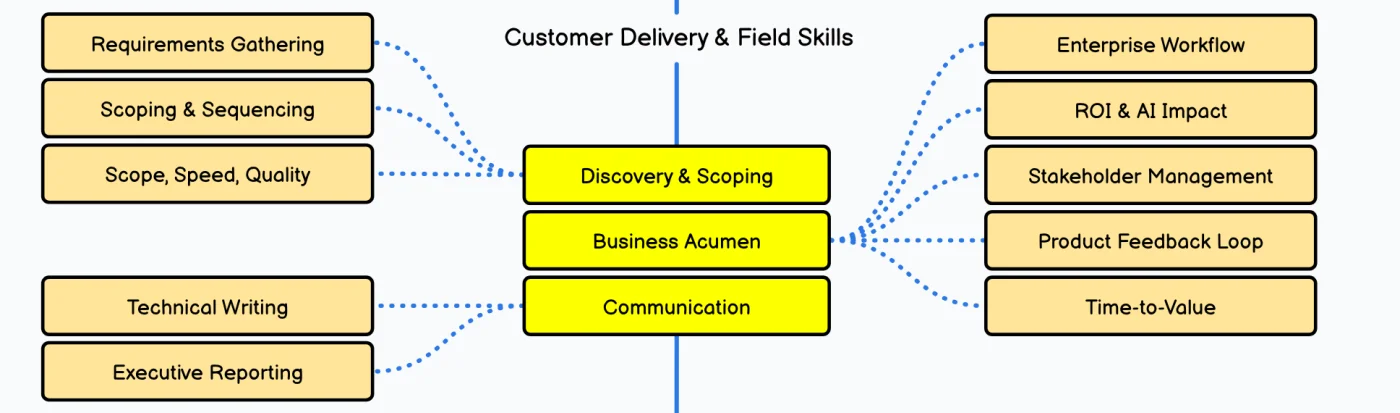
The last group is what makes an FDE different from other engineers. Many good developers do not enjoy customer meetings. FDEs need to be comfortable with them.
A roadmap you can follow
If you are starting from zero, this order works well. Each stage builds on the one before.
- Use AI at work and automate simple processes. Learn how language models behave, where they make mistakes and how to use them safely with real data. Build a few automations with a tool like n8n and connect them to APIs. This teaches you to look at a business process and find what can be automated, which is exactly what FDEs do with customers.
- Learn to build software. JavaScript or TypeScript, React, Node.js, SQL and PostgreSQL, Git, tests, Docker and CI/CD. Finish with one complete app that is deployed and used by someone.
- Build AI systems. Python, RAG, agents with tools, evaluations and cost estimates, and reliable integrations with logging and alerts. Build a system that a real team could use, with documentation and a handover.
- Learn cloud and production. AWS, infrastructure as code, monitoring, security, MLOps, and running models privately when data must stay inside the company.
- Practise the customer side throughout. For every project, write down the problem, who the users are and how you will measure success. Present your results. Write a short handover document. These are the things FDE interviewers ask about.
Then build a portfolio that looks like FDE work: two or three projects where you took a real process, built an AI system for it and can show what changed. "Reduced the time to answer support emails from two days to four hours" says more than a list of tools.
German matters. Many FDE roles in Germany work with German companies, and some ask for native or fluent German. If your German is not strong yet, work on it alongside your training.
How the Bildungsgutschein fits in
A Bildungsgutschein is a training voucher from the Agentur für Arbeit or Jobcenter. It can cover the cost of an approved training course when your advisor confirms that the course fits your situation on the job market.
How it usually works:
- You are registered with the Agentur für Arbeit or Jobcenter, for example because you are unemployed or will soon be.
- You choose a course that is approved for funding (AZAV). The course should lead to a clear job goal.
- You talk to your advisor and explain why this training improves your chances of finding work. A course description and information about job demand help.
- Your advisor decides. If they approve, you get the Bildungsgutschein and can start the course.
FDE itself is too new and too senior to be a direct training goal. In your conversation with the advisor, it makes more sense to name the jobs you can apply for right after the training, such as AI engineer, AI automation engineer, software developer or cloud engineer. FDE is where you want to go next.
Our Bildungsgutschein guide explains the process in more detail, including the documents you need.
Which Ai School program leads toward FDE
Our programs follow the same order as the roadmap above. Each program is made of three-month blocks, and the longer programs add blocks on top of each other.
| FDE skill area | Where it is covered at Ai School |
|---|---|
| Using AI at work, automation, APIs | Block 1: AI & automation (n8n, APIs) |
| Full-stack development | Block 2: React, TypeScript, Node.js, PostgreSQL, Docker, CI/CD |
| AI engineering and integration | Block 3: Python, FastAPI, RAG, agents, evaluation, reliable integrations |
| Cloud and production AI | Block 4: AWS GenAI, MLOps, monitoring, security, private LLMs |
| Data privacy and governance | All blocks: GDPR and the EU AI Act from the start |
| Customer skills | Capstone projects in every block: defining the problem, a demo, documentation and handover |
If you are new to tech: the Full Stack AI & Cloud Engineering Program (12 months full-time) is the closest match. It covers all four blocks, from AI at work to production AI on AWS, and ends with several capstone projects for your portfolio. It also prepares you for the Google AI, AWS Cloud Practitioner and AWS AI Practitioner certifications.
If 12 months is too long: the AI Systems & Automation Developer Program (9 months) covers blocks 1 to 3. You learn AI at work, full-stack development and AI systems with RAG, agents and evaluation. It does not include the cloud and MLOps block.
If you are already a developer: the Advanced AI Systems & Cloud Engineering program (6 months) skips the basics and covers AI systems, AWS GenAI, MLOps and private LLMs. This is the shortest path to the technical skills on the FDE roadmap.
How we help our students with job searching at Ai School
Finishing a program is the first step. Getting the first job is the second. Career coaching is part of our programs. During and after the program, our students get help with their CV and LinkedIn profile, interview practice and support with the job search on the German job market.
For a future FDE, that means presenting your capstone projects the way FDE interviewers want to hear them: what the problem was, what you built, and what changed.
See our programs to compare them, read how the Bildungsgutschein works, or apply now.
Programs that match this guide
More guides
- Job search with Claude: find jobs, tailor your CV, prepare applicationsThree ways Claude can help with your job search: find matching jobs on the web, search career pages and pre-fill applications, and create a CV for each job as a PDF. With ready-to-use prompts.
- Ollama setup: run AI on your own laptopWhy a local language model makes sense when data should not leave the building, and how to set up Ollama in four steps on macOS, Windows or Linux. Every command comes from the official docs.
- Getting started with AI at workFive practical steps to use AI at work safely and measurably — without the hype.